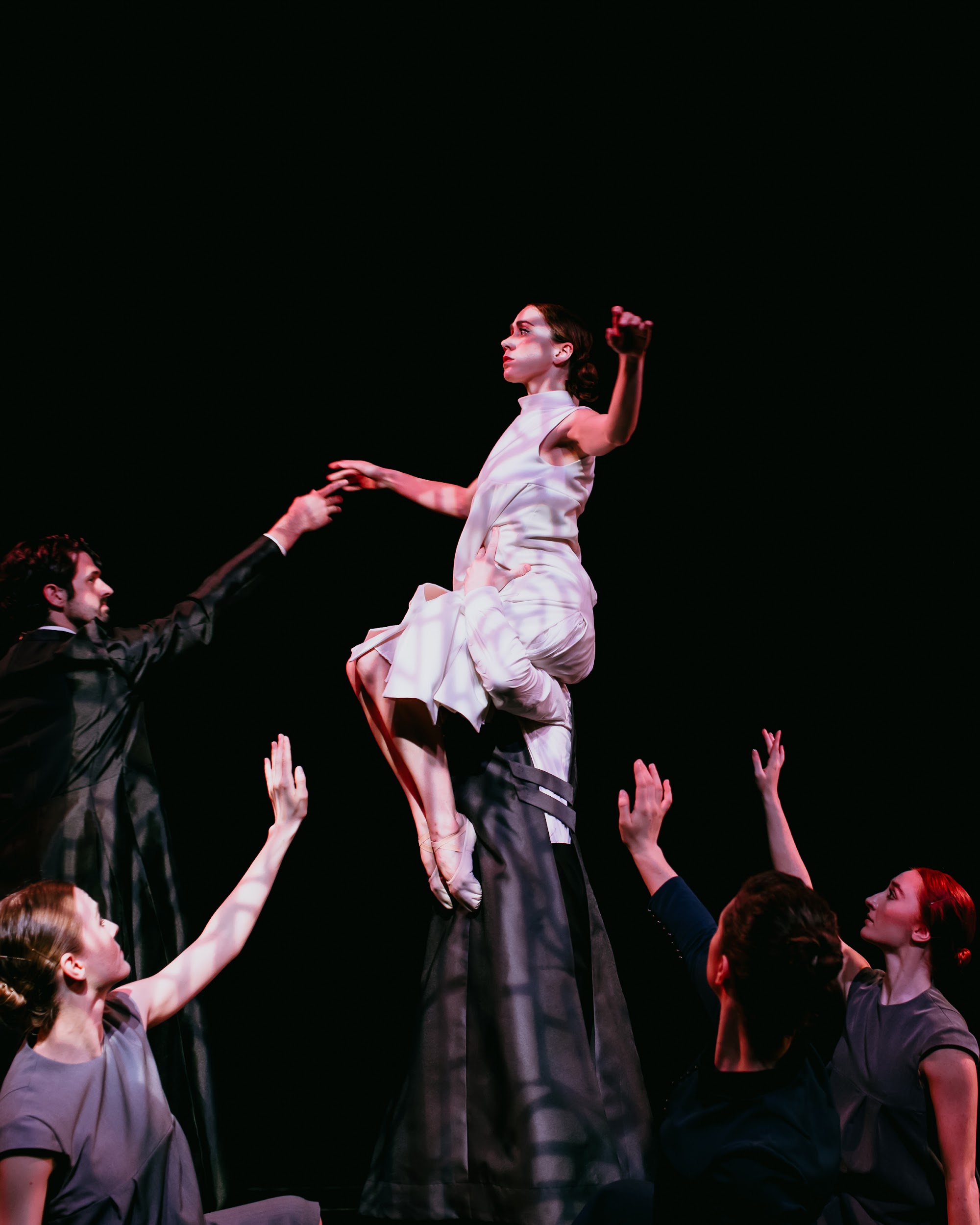
From Ballet Des Moines' Salem · Tom Mattingly, choreographer · Stoner Theater, October 2022
An exploration of values, fear, and implicit bias — through theater games, history, and performed dialogue.
Three class periods, three movements — from safe self-exploration, through historical context, to recognizing and reshaping bias today.
Use the Values Spectrum and Association Circle to safely explore our differences — and notice the stereotypes that surface first.
Use Visual Thinking Strategies on a scene from Salem, read the history, and map "big ideas" onto the choreography.
Learn where implicit bias comes from, see modern examples, then play the Reshape theater game.
Values, assumptions, and the words that surface first.
Before discussing a difficult topic, a group needs to feel safe with one another. Theater games let students surface their own values and notice their automatic assumptions in a low-stakes setting. The goal isn't to land on right answers — it's to practice listening, sharing, and noticing what we already believe.
Create a long line in the classroom — one end is A, the other B. Read each prompt below. Students move to the end of the spectrum that fits them best, or stand somewhere in the middle. Students can step out of the line at any time. Invite (don't require) sharing.
Q. How might our diversity of traits and values benefit our classroom community?
Q. In what ways might different values cause confusion or conflict?
Q. How might a person's cultural background or life experience shape their values?
Stand in a circle. The leader calls one value word from below. The next student speaks or moves the first thing that comes to mind. The next student responds to what the previous student did — and so on around the circle. Play fast. The final word may have nothing to do with the first.
Q. Common stereotypes often surface first — "BRAVERY" → "soldier." What stereotypes did you notice in this game?
Q. Did anyone offer a response that broke the stereotype? ("BRAVERY" → "Grandma.") How did that shift the word's meaning?
We all hold automatic beliefs and stereotypes shaped by our experience and culture. But stereotypes don't capture the richness and complexity of real people.
Write a short paragraph about someone you admire — or about yourself — who doesn't fit the mold. What makes this person defy a stereotype? What surprises people about them?
A historical lens for the bias we still carry.
In October 2022, Ballet Des Moines premiered Salem — Tom Mattingly's choreographic response to the 1692–93 witch trials. The ballet didn't retell the trials literally. It expressed the "big ideas" behind them through movement: fear, mob mentality, unchecked power, and the bias that turns neighbors into accusers.
Project or print the photo from BDM's Salem. Ask three questions, in order, and let each one breathe before moving on:
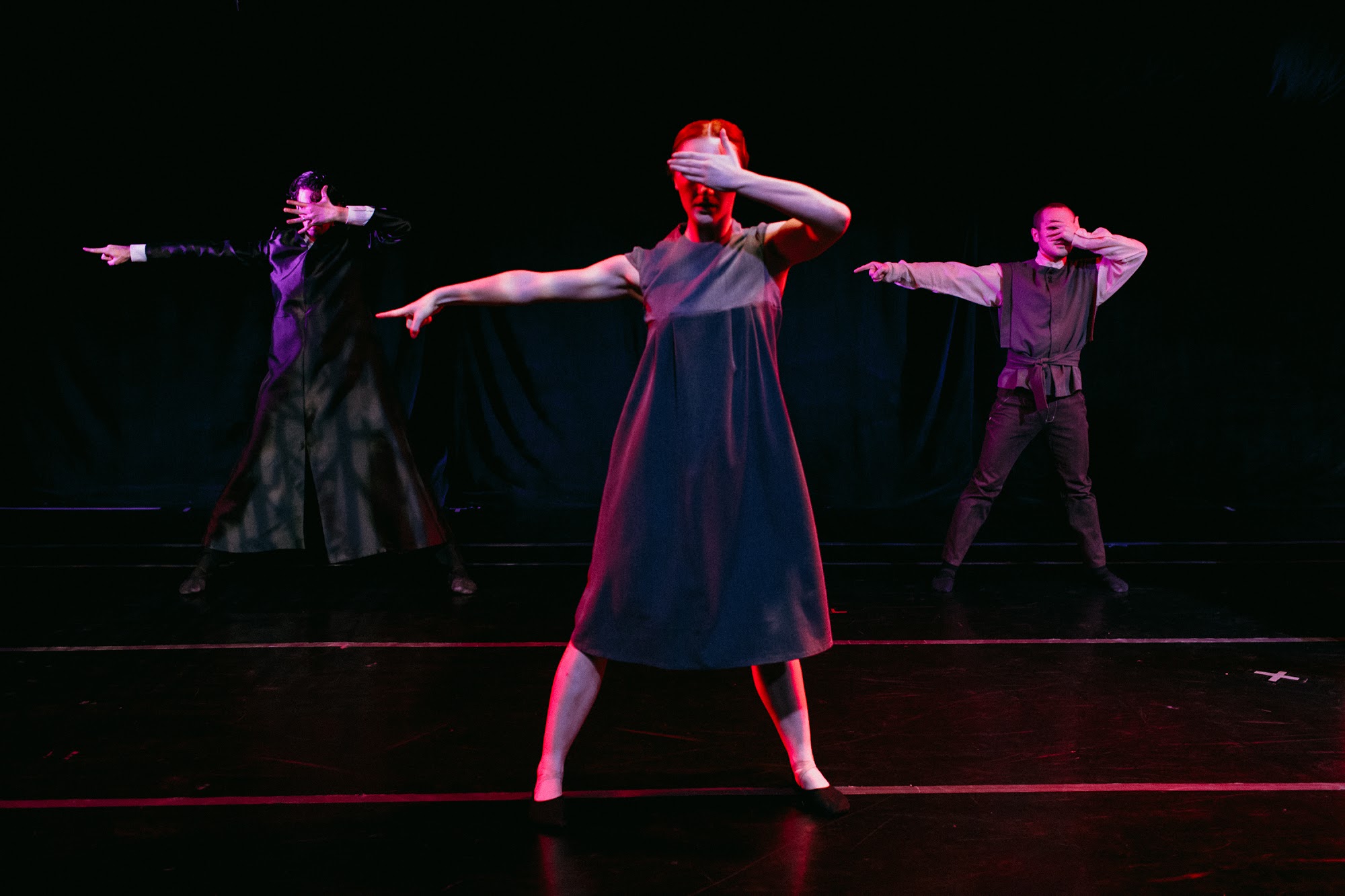
The goal isn't a "correct" interpretation. The photo could read as accusation, paparazzi spotting a celebrity, or parents finding a lost child. The point is to notice that the same evidence can support many readings — a habit that will become essential as we discuss Salem.
Read the history below silently. Keep sticky notes nearby and capture: questions that come up as you read, and emotions you notice yourself feeling.
The Salem witch trials were a series of trials in colonial Massachusetts. Over the span of a year, 200 people were accused of witchcraft and 20 were executed. Fourteen of those executed were women. Five more, including two toddlers, died in prison.
Fear in Salem Village began when nine-year-old Betty Parris and her eleven-year-old cousin Abigail Williams had fits — screaming, throwing things, contorting their bodies. Doctors found no physical cause. The townspeople, mostly Puritans, suspected witchcraft. The girls were pressured to identify who had bewitched them.
The first three accused were Sarah Good, a homeless beggar; Sarah Osborne, a woman who rarely attended church; and Tituba, an enslaved African or American Indian woman. Each was already an outsider — the "usual suspect" profile for witchcraft accusations in Puritan New England.
Once trials began, a wave of accusations followed. Many of the accused were outsiders in some way. The accused were assumed guilty until proven innocent. In court, "spectral evidence" — what the girls claimed to see in dreams — was admissible. The "facts everyone knew" stacked against the accused before testimony began.
Mattingly built the ballet around five "big ideas." Read them aloud, then have students place their sticky notes from the reading next to whichever big idea their question or emotion most connects with.
Q. Which "big idea" attracted the most sticky notes? Why might that one resonate most with the group?
Q. Which questions or emotions surprised you? Which seem to fit more than one big idea?
Return to the production photo. Now that the class knows the "big ideas," ask: which big idea(s) do you see in this scene? What evidence supports your answer?
Each student writes thought bubbles for the characters in the photo. What might each one be thinking or saying in this moment? Use the questions and emotions on the sticky notes as inspiration.
Then choose volunteers to recreate the scene with their bodies. Once they're frozen in position, the teacher taps each performer on the shoulder. When tapped, that performer speaks the words they wrote in their thought bubble — bringing their character's interior to life.
Run the scene more than once. Each time, ask: How can the performers' voices, faces, or bodies portray the emotions of this moment more clearly?
It happened in Salem. It still shapes our world.
Implicit bias was one of many factors that fueled the injustice of the Salem witch trials. But because implicit bias is an unconscious mental process, it didn't end in 1693 — it shapes the way we live now. The good news: once we can name it, we can also work against it.
Everyone has implicit bias. It comes from four ordinary mental habits:
Read each card aloud. Pause after each to ask: have you seen this happen — at school, online, or in your community?
A teacher assumes a student with a physical disability isn't as capable, and gives them easier work. Or assumes all Asian students excel at math, and doesn't notice when one needs extra support.
Online groups reinforce stereotypes based on age, ethnicity, gender, or body type. Those generalizations then shape how we view individuals we meet in real life.
Employers are more likely to interview "Robert Smith" than "Jorge Alvarez" or "Zhao Wei." When names are removed from resumes, more diverse candidates get interviews.
The U.S. Sentencing Commission reports that Black men receive sentences 13.4% longer, and Hispanic men 11.2% longer, than white men for the same crimes.
Many doctors are reluctant to treat patients with obesity, believing they are "lazy" or "undisciplined" and won't follow treatment plans — so patients receive less care, not more.
Q. What examples of implicit bias have you noticed in your school, family, or community?
Q. When have you noticed someone working against their own bias — or helping someone else notice theirs?
Choose a literary or historical character treated unfairly because of bias and stereotyping — Tituba from the Salem trials is a natural choice. A small group of 5–6 students decides on a frozen pose that reflects the way the character is seen and stereotyped by others. One by one, they take the stage in that pose, saying "I am Tituba."
Audience members reshape the performers: "You are Tituba, and ___" — completing the sentence with something that gives a more complete understanding of the character.
Although we all have implicit bias, we can work against the kind of injustice the Salem witch trials produced. Four practices help:
What attitudes do you have toward people based on their body, race, gender, religion, sexuality, wealth, politics?
Trace where the attitude came from — and whether it's actually accurate.
Look for something surprising or unique about every person you meet.
When all your friends and feeds agree with you, seek a different point of view.
Q. In the game, it was the audience's job to reshape the picture onstage. What responsibility do we have in real life to help others be seen without bias?
Q. In history or in literature, who has stepped in to reshape how someone was seen? Why did they do it? What did they risk?
Assessment, differentiation, and notes from the field.
The complete lesson plan — fully designed, ready to print or project, with student-facing handouts.
Download Lesson Plan (PDF)